Quick Answer (TL;DR)
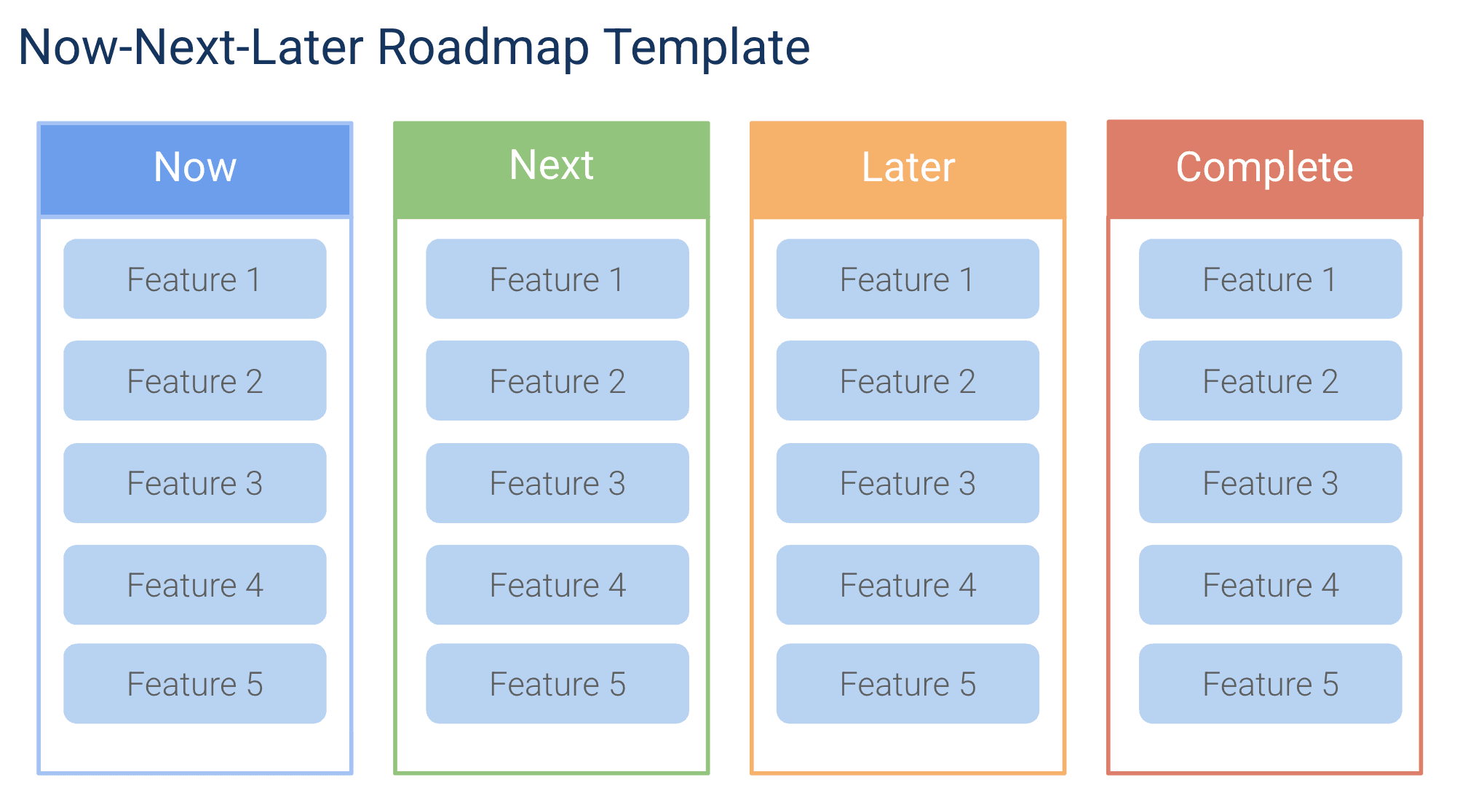
This free Google Slides now-next-later roadmap template organizes your product plan into three buckets -- what you are building now, what comes next, and what is on the horizon for later. It communicates direction without committing to specific dates, making it the ideal format for agile teams that resist false precision in their roadmaps.
What This Template Includes
Why Use Google Slides for a Now-Next-Later Roadmap
The now-next-later format is inherently a communication tool -- it exists to tell stakeholders where the product is headed without overcommitting to dates. Google Slides is the natural home for this because the slide format is designed for storytelling and presenting.
The three-column layout translates perfectly to a single slide, making it easy to show the full picture at a glance. Unlike spreadsheet or timeline-based roadmaps that require scrolling, a now-next-later slide delivers the complete message in one view.
Google Slides also makes it easy to maintain multiple audience-specific versions. Create one deck for the engineering team (with technical detail), one for leadership (with strategic themes), and one for customers (with user-facing language). Each version uses the same structure but curates the content for its audience.
Template Structure
Now -- Current Commitments
The Now column contains work that your team is actively executing or will begin within the current sprint or iteration. Items here should have clearly defined scope, an assigned owner, and acceptance criteria. Because this column represents firm commitments, keep it deliberately small -- typically three to five initiatives for a single product team. Overloading the Now column defeats the purpose of the framework; it should signal focus, not a dumping ground for everything that feels urgent. In Google Slides, use high-contrast card styling for Now items to visually emphasize their priority.
Next -- High-Confidence Priorities
Next holds initiatives that have been validated and prioritized but are not yet in progress. These items have gone through enough discovery that the team is confident they belong on the roadmap, even if final scope is still being refined. The Next column gives stakeholders visibility into what is coming without creating a hard promise on delivery dates. A healthy Next column typically holds five to ten items and is reviewed every two to four weeks.
Later -- Exploration and Opportunity
The Later column is where ideas, opportunities, and strategic bets live while they await further research or validation. Items here carry the lowest level of commitment. They may move to Next after customer discovery confirms demand, or they may be removed entirely if the market shifts. Treating Later as a living backlog rather than a fixed plan prevents roadmap bloat and keeps your team focused on what actually matters right now. In the slide, use lighter styling or smaller cards for Later items to reinforce the lower commitment level.
Confidence and Effort Tags
Every card in this template includes a confidence indicator (High, Medium, Low) and a t-shirt-size effort estimate (S, M, L, XL). These tags give reviewers an at-a-glance understanding of how certain the team is about each initiative and how large the investment will be. Over time, you can track how confidence levels change as items move from Later to Next to Now, providing useful data for improving your estimation accuracy.
Review and Transition Rules
The template ships with a lightweight governance section that defines when and how items move between columns. A typical cadence is a weekly check on Now, a biweekly review of Next, and a monthly reassessment of Later. Establishing these rules up front prevents ad-hoc reshuffling and ensures that the roadmap stays a reliable source of truth.
How to Use This Template
1. Define your time horizons
Make a copy of the template. Define what Now, Next, and Later mean for your team. Common definitions: Now = current sprint or month, Next = next 1-3 months, Later = 3-6 months out. Add these definitions to the slide so the audience shares your frame of reference.
Why it matters: Shared definitions prevent the confusion that arises when one person's "Next" is another person's "Later." Starting with a complete list of candidate initiatives ensures nothing falls through the cracks and sets the stage for honest prioritization.
2. Fill the Now column first
List the initiatives your team is actively working on. These should be specific and concrete -- the audience should be able to verify that these items are actually in progress. Include 3-5 items maximum. Add high confidence badges to all Now items.
Why it matters: A lightweight scoring model removes gut-feel bias and gives the team a shared language for discussing trade-offs. Explicit column placement forces you to make priority calls rather than labeling everything as high priority.
3. Populate Next with planned work
Add initiatives that are committed for the near future but not yet started. These should be well-defined enough to estimate but may shift in sequence. Mark them with medium to high confidence. Include 3-6 items.
Why it matters: Context-rich cards reduce the need for follow-up meetings and let anyone reading the roadmap understand the intent behind each initiative.
4. Add Later as directional bets
The Later column is for strategic direction, not specific commitments. Items here may change significantly or get reprioritized. Mark them with low to medium confidence. Use theme-level descriptions rather than specific features. Include 3-5 items.
Why it matters: Keeping Later at a low fidelity level sets the right expectation that these items are under exploration, not committed. It prevents stakeholders from treating every item as a promise.
5. Present with the confidence narrative
When presenting, explicitly explain the confidence gradient. Now items are committed. Next items are planned but flexible. Later items are directional. This framing prevents stakeholders from treating every item as a date commitment.
Why it matters: A roadmap that is never reviewed becomes stale. Regular cadence keeps it alive and trustworthy. Schedule recurring reviews using the cadence guide -- weekly for Now, biweekly for Next, monthly for Later -- and assign a facilitator with clear decision rights for who can move items between columns.
When to Use This Template
The Now-Next-Later framework is ideal for teams operating in environments where requirements change frequently and long-term date commitments are unrealistic. If your organization ships continuously rather than on fixed release trains, this template will feel natural. It is especially effective for early-stage startups that need to communicate direction to investors and advisors without over-committing on timelines. Google Slides makes this communication presentation-ready for board meetings, advisory sessions, and team all-hands.
Mid-size product teams managing a single product line will also benefit. The framework scales well from a team of three to a department of thirty, as long as each team maintains its own board and a portfolio-level view aggregates the Now columns across teams.
This template is especially effective for stakeholder audiences that tend to treat roadmap dates as promises. By removing dates entirely and replacing them with confidence levels, you can share direction without creating accountability for timing that you cannot control. It also works well for public or semi-public roadmaps -- customer advisory boards, blog posts, or investor updates -- where you want to share what is coming without making contractual commitments.
The template is less suitable for environments that require contractual delivery dates, such as enterprise implementations with SLA-bound milestones. In those cases, a timeline-based roadmap may be a better fit. However, many teams use a Now-Next-Later roadmap for external and executive communication while maintaining a date-based roadmap internally for sprint planning.